


Shaping International Careers Through Industry-Aligned Technical Education
- Stanly Madugalle
- Jan 14
- 4 min read
Many young people enter the transition period between school and higher education without a clear sense of the pathways available to them, particularly in technical disciplines, which are in exceptionally high demand presently and offer accelerated routes to meaningful career growth. At the center of these opportunities is plant engineering, now recognized globally as a sought-after technical field that unites essential engineering disciplines the modern world can no longer operate without.
An exploration into the Diploma in Plant Engineering offered by the DIMO Academy, the vocational education arm of DIMO, reveals why this qualification – underpinned by German training standards and international accreditation – is increasingly being viewed as a career defining entry point for youth aspiring to secure global technical employment. The programme’s structure, industry linkages and graduate outcomes position it as a unique bridge between local talent and international job markets at a time when global demand for plant engineering expertise continues to accelerate.
Plant engineering – by definition – integrates mechanical, electrical and plumbing (MEP); heating, ventilation and air conditioning (HVAC), and other engineering systems, required to design and maintain complex industrial and commercial infrastructure. From manufacturing plants and power facilities to smart buildings and sustainable water systems, the field supports the operational foundations of modern economies.
As industries across Europe, the Middle East and Asia shift towards energy efficient systems and advanced automation, the role of plant engineers has expanded from maintenance focused responsibilities to solutions driven, innovation-oriented functions. Countries undertaking large-scale infrastructure modernization have seen a shortage of skilled technicians, creating extensive opportunities for internationally trained professionals.
Interviews with vocational training stakeholders and German industry partners highlight a consistent trend: the demand for qualified plant engineering professionals is outpacing supply. Germany’s building services and energy efficiency sectors, in particular, have experienced a surge in workforce requirements due to national commitments to sustainability, and the modernization of public and private infrastructure.
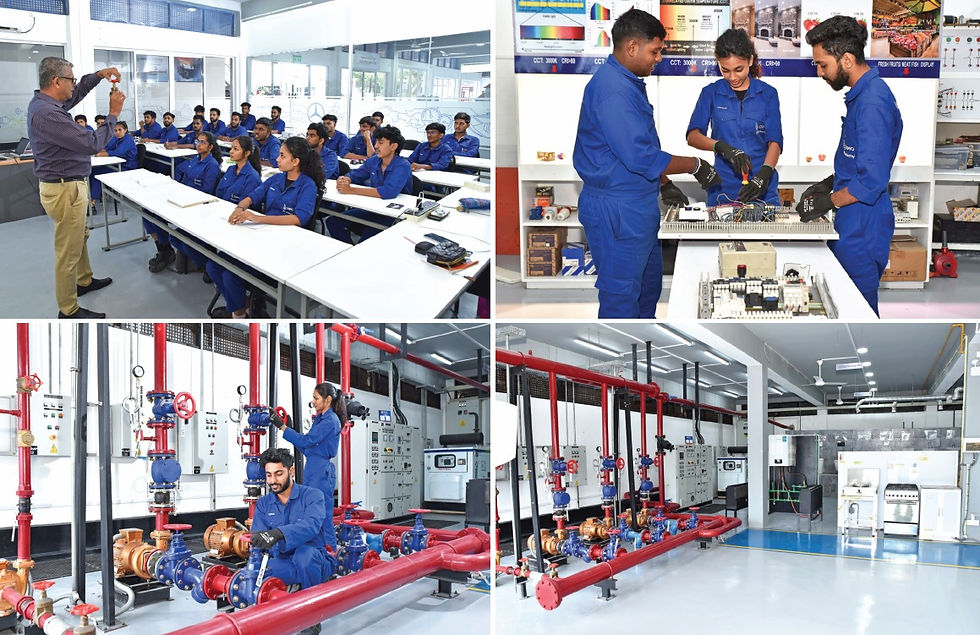
A closer look at the Diploma in Plant Engineering offered by the DIMO Academy reveals a curriculum that is thoughtfully aligned with international technical standards and developed with input from German industry experts. The programme features a robust set of engineering modules that strike a balance between theoretical knowledge and practical application, equipping students with job ready competencies upon graduation.
Core modules include Workshop Practices & Safety, Engineering Drawing, Electrical Technology, Potable Water Systems (both hot and cold), HVAC, Plumbing & Sanitary Systems, Sustainable Building Solutions and Extra-Low Voltage (ELV) Systems. Each module is complemented with practical workshops, industry projects and simulation exercises conducted at the DIMO Academy’s state-of-the-art training facility in Peliyagoda. This approach reflects German vocational training principles – emphasizing precision, real world experience and industry alignment.
A key differentiator lies in the programme’s accreditation. The Diploma in Plant Engineering is endorsed by the German Chamber of Industry and Commerce Sri Lanka (AHK), affirming that graduates meet competency standards recognized across Germany and Europe. This recognition carries substantial weight in technical fields where employers prioritize standardized, globally benchmarked qualifications.
The programme is also registered with Sri Lanka’s Tertiary and Vocational Education Commission (TVEC), ensuring compliance with national regulatory requirements under the Tertiary and Vocational Education Act No. 20 of 1990. This dual recognition strengthens the credibility of the qualification for both domestic and overseas employment.
The DIMO Academy’s training ecosystem integrates modern teaching methodologies, world-class laboratories and access to trainers who possess international certifications. Many lecturers have undergone advanced training in Germany, bringing valuable exposure to methodologies used in sophisticated industrial environments. Regular curriculum updates, consultations with industries and close engagement with German institutions ensure that course content remains aligned with global needs.
The DIMO Academy’s selective admission process also ensures that students entering the programme demonstrate both aptitude and motivation, which are key attributes for success in technical fields. And the DIMO Academy’s longstanding partnership with the HomeServe Group in Germany directly connects their graduates to these global gaps. This collaboration has formalized a pathway enabling graduates to secure employment as technical professionals in Germany’s building services companies.
Opportunities such as these offer local youth access to stable, high income roles and positions traditionally out of reach without international certification or specialized expertise. One of the most distinctive features of the programme is its structured placement pathway. Graduates pursuing opportunities in Germany receive coordinated assistance with language training, documentation and visa preparation. This level of support reduces barriers that often prevent capable local technical graduates from accessing global careers.
While engineering sectors traditionally attract fewer women, the DIMO Academy has introduced targeted initiatives such as scholarships for female learners, awareness campaigns and mentorship programmes to improve gender representation in plant engineering. Outreach programmes conducted in schools further encourage young women to explore careers in engineering, an important shift for a field that benefits from diverse technical perspectives.
The employability outcomes of the programme are best reflected in the trajectories of its students. Dasun Amarasinghe – a DIMO Academy Plant Engineering graduate, currently employed at Barella Gebäude- und Energietechnik in Germany – says: “This diploma equipped me with the technical competencies, practical training and confidence required to excel in an international engineering environment. Working in Germany has provided me with exposure to advanced technologies, and a professional culture that values precision and efficiency.”
Hansi Panchali, a current student who is following a Diploma in Plant Engineering at the DIMO Academy, adds: “The programme offers a unified approach to plant engineering disciplines rarely found in other institutions. The practical problem-solving skills gained through real world simulations have been particularly valuable in understanding industry expectations and developing fast, effective solutions to technical challenges.”
For students completing their A-Levels this year, and parents and educators guiding the next generation, the DIMO Academy’s Diploma in Plant Engineering offers a timely, credible and internationally recognized route into one of the world’s most critical technical sectors. Backed by over 35 years of vocational training excellence, the DIMO Academy continues to equip youth with the capabilities and exposure required to thrive in global industry environments.
With intake cycles open twice a year and entry options available for both O-Level and A-Level students, the programme stands as a future ready pathway bridging education, industry and international opportunity at a pivotal moment for Sri Lankan youth.
Stay engaged with DIMO for continued insights into how future-focused education and industry integration are opening doors to global careers.
Credit goes to: LMD magazine for the original editorial material adapted in this blog.


Comments